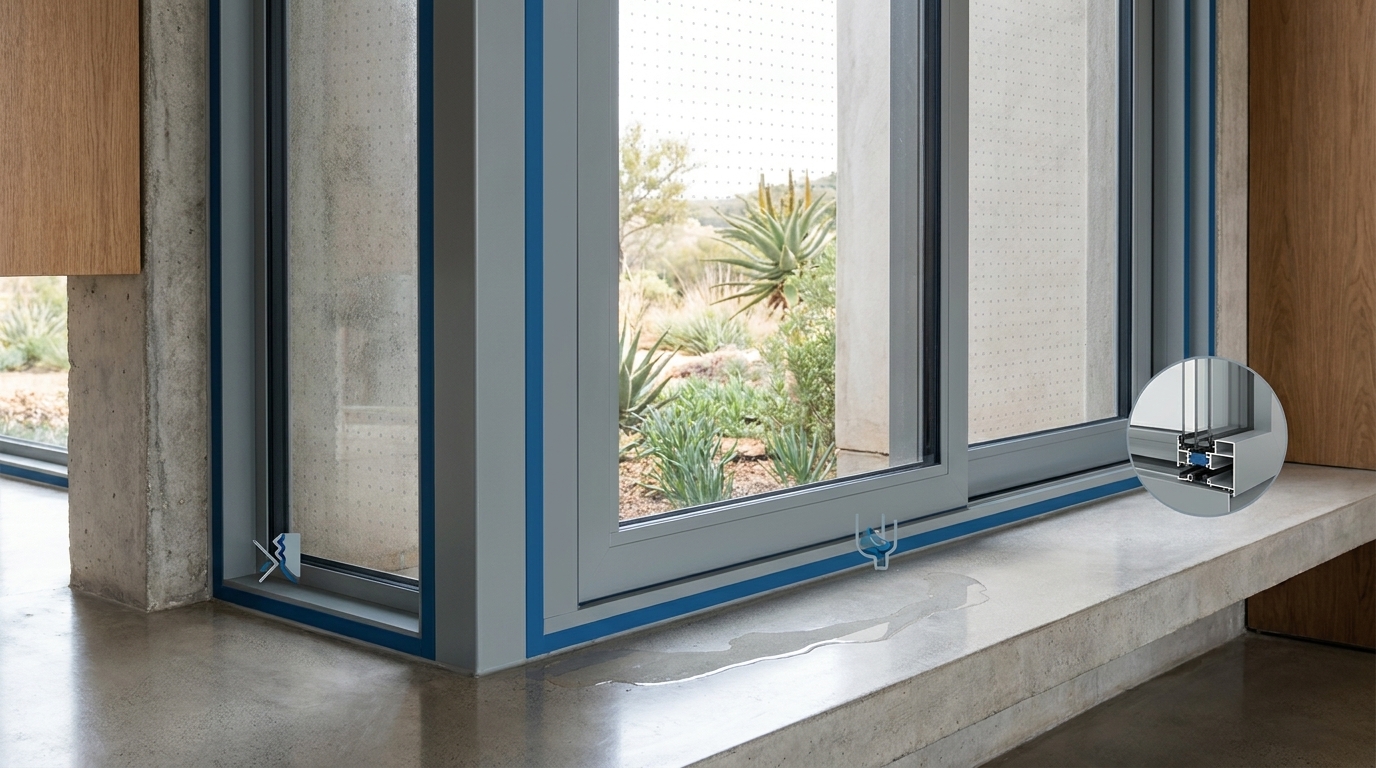
A damp patch on the sill after a Cape Town southeaster, or a puddle beneath a Highveld thunderstorm window, is easy to dismiss as a minor irritation. But leaking aluminium window repair is one of those jobs that rewards early action and punishes delay. Water that finds its way past a window frame does not stop at the sill. It travels. It finds timber, plaster, and insulation, and once it settles in, the resulting damage far outweighs the cost of fixing the leak itself. Understanding exactly where the failure has occurred is the starting point for any effective repair, and that is what this guide is designed to help you do.
Table of Contents
The Four Root Causes of a Leaking Aluminium Window

Aluminium frames are inherently corrosion-resistant and dimensionally stable, which is why they outlast timber and uPVC in South Africa’s demanding climate. When they do leak, the frame itself is almost never to blame. The failure almost always sits in one of four places: the weather gasket, the perimeter sealant, the glazing bead, or the building’s structure. Identifying which one is responsible determines the correct repair and prevents you from spending money on the wrong solution.
Perished or Compressed Weather Gaskets
What you will see: Water appears directly on the inner sill, often in a thin line that follows the bottom rail of the opening sash or the fixed frame. After heavy rain, the sill is wet, but the surrounding plaster is dry. The water is tracking inward through the frame profile itself, not around it.
Aluminium windows use rubber or EPDM gaskets pressed into a channel along the frame’s inner perimeter to create a compression seal between the opening sash and the fixed frame. Over time, UV exposure, temperature cycling, and repeated compression cause these gaskets to harden, flatten, or pull away from the corners. Once that happens, wind-driven rain has a direct path into the building.
The fix: This is an aluminium window gasket replacement scenario. The old gasket is removed from its channel, the channel is cleaned, and a new gasket of the correct profile is pressed in. Corner joints must be sealed with a compatible adhesive to prevent the new gasket from lifting. This is a skilled job because the gasket profile must match the original frame extrusion precisely – an incorrect profile will not compress properly, and the leak will persist. Inso can source replacement gaskets for a wide range of frame profiles and advise on compatibility before any work begins.
Failed Perimeter Sealant Between Frame and Reveal
What you will see: Damp patches on the plaster beside or below the frame, sometimes with a tide-mark stain. The glass and the sill inside the frame are dry. The moisture is appearing in the wall, not on the window itself. In severe cases, paint bubbles or peels away from the plaster adjacent to the frame.
When an aluminium window is installed, the gap between the outer aluminium frame and the masonry or plaster reveal is filled and finished with a flexible sealant, typically a silicone or polyurethane compound. This sealant must remain bonded to both surfaces and flexible enough to accommodate the minor movement every building experiences. After several years of thermal expansion and contraction, UV degradation, or in cases where the original sealant bond was poor, this joint cracks, lifts, or simply gaps open. Rain then enters the wall cavity rather than tracking down the outer face, which is why the symptom appears in the plaster rather than on the sill.
The fix: A window seal repair at the perimeter. The old sealant must be fully removed, the reveal and frame surfaces cleaned and primed, and a fresh bead of appropriate flexible sealant applied in a continuous, unbroken run. Painting over cracked sealant or applying a new bead on top of a failed one will not hold. The substrate preparation is what determines whether the new seal lasts five years or fifteen.
Glazing Bead Movement and Internal Glass Seal Failure
What you will see: Condensation or fogging between the two panes of glass in a double-glazed unit. The moisture is trapped inside the unit and cannot be wiped away. Separately, water may appear on the inner sill even when the weather gasket and perimeter sealant appear intact.
The glazing bead is the aluminium strip that holds the glass unit within the frame. If the bead works loose due to thermal movement or impact, the bedding compound or tape that seals the glass to the frame is disturbed. This can allow water to track between the glass edge and the frame internally. In double-glazed units, the more visible symptom is inter-pane condensation, which indicates that the hermetic seal of the insulated glass unit itself has failed, often accelerated by water ingress at the bead.
The fix: Loose glazing beads can sometimes be re-secured and the glass rebedded. Fogged double-glazed units, however, cannot be cleared: the desiccant inside the unit is saturated, and the seal is permanently compromised. The glass unit must be replaced. This is a re-glaze scenario, not a sealant job, and attempting to seal around the outside of a failed unit will not restore its thermal performance or clarity.
Frame Distortion from Structural Movement
What you will see: The opening sash drags, sits unevenly in the frame, or will not close flush. Water enters at an inconsistent point, sometimes at the top corner, sometimes along one side, depending on where the gap has opened. The building may be older, or the window may be close to a lintel or a door opening that has settled.
Aluminium frames are dimensionally stable, but the openings they sit in are not always. Subsidence, lintel deflection, or seasonal soil movement can rack a masonry reveal out of square. When the reveal moves, it pulls the frame with it. A frame that is no longer square will not close correctly, and the compression seal around the sash becomes uneven. Some sections are over-compressed while others gap open entirely.
The fix: Resetting the frame within the opening, shimming it back to square, and re-sealing the perimeter. In cases of significant structural movement, a structural engineer’s assessment may be warranted before any window repair is carried out. Resealing a distorted frame without correcting the racking will produce another failure within months.
Why a Leaking Aluminium Window Is Urgent, Not Optional

It is tempting to manage a leaking window with a towel on the sill and a mental note to get it looked at next season. The problem is what happens in the meantime.
Timber sub-frames and window boards that remain damp begin to rot from the inside out. By the time the surface shows damage, the structural deterioration is often well advanced. Plaster absorbs water readily, and once the salts within it begin to effloresce and the paint film lifts, full replastering of the affected area is usually unavoidable. Mould follows moisture within days in a warm climate. Black mould on plaster adjacent to a window frame is a health concern, particularly in bedrooms and bathrooms, and it is a signal that the wall cavity has been wet for some time.
There is also an insurance dimension that many homeowners overlook. Most building insurance policies contain an exclusion for damage caused by gradual water ingress or lack of maintenance. A claim for water damage that an assessor traces back to a failed window seal may be declined on exactly those grounds. Documenting a repair and keeping the invoice on file is a straightforward way to protect that cover.
None of this means that every leaking window requires an emergency call-out. It does mean that diagnosing the cause and acting within a reasonable time is worth more than the repair itself.
Can You Repair It Yourself?

Perimeter sealant replacement is within reach for a careful and patient DIY homeowner, provided the surfaces are prepared properly and the correct sealant type is used. Applying new silicone over wet, dirty, or primed surfaces is the most common reason a DIY re-seal fails within a season.
Gasket replacement and re-glazing, however, are best left to a professional. Sourcing the correct gasket profile for your specific frame system is not straightforward, and an incorrect profile will not seal regardless of how carefully it is fitted. Re-glazing requires handling sealed glass units safely and ensuring the new unit is correctly bedded and drained within the frame. Getting either of these wrong means another leak and another repair bill.
For anything beyond basic perimeter sealant, a professional assessment gives you an accurate diagnosis before any money is spent. It is also the point at which you find out whether the frame itself has been distorted, which a surface inspection alone cannot reveal.
Leaking Aluminium Window Repair: Inso’s Photo-to-Quote Process
Inso Aluminium supplies gaskets, sealants, and replacement components for a broad range of aluminium window systems. If you are unsure which gasket profile your frame uses, our team can identify it from a close photograph of the frame channel and the existing gasket cross-section.
The process is straightforward. Photograph the leak location, the outer perimeter joint, the glazing bead area, and any visible gap in the sash seal. Send those images through our contact page with a brief description of when and where the leak appears. Our team will assess the likely cause, confirm whether the repair falls under gasket supply, re-sealing, or re-glazing, and provide a quote accordingly.
For homeowners considering whether a repair is worthwhile against the cost of a new window, our aluminium windows pricing guide gives a clear picture of replacement costs, which often makes a well-executed repair look like excellent value.
If the inspection reveals that the frame has reached the end of its serviceable life, our full range of aluminium windows covers everything from standard sliding configurations to awning, casement, and fixed-pane designs, all manufactured to current weatherproofing standards.
Act Before the Next Rain Season
A leaking window that has been dripping for one season is a maintenance issue. One that has been dripping for three is a renovation project. The four causes above cover the vast majority of aluminium window water leaks, and in most cases the correct repair is straightforward once the right cause has been identified.
Start by watching where the water appears and when. That observation alone will usually point you toward gasket, sealant, glazing, or structure, and from there the repair path is clear. If you are uncertain, send Inso a few photographs before committing to any work. A correct diagnosis costs nothing. A repair carried out on the wrong assumption costs time, money, and another leak.
Ready to get to the bottom of your leak? Contact our team with your photos, and we will help you work out exactly what your window needs.